Showing posts with label Indianapolis. Show all posts

Friday, March 1, 2019

Opera, Book, and Kindle

Three recent new works explore aspects of the 1913 flood in Columbus, Indianapolis, and Dayton

Virtually all books, videos, and other works about the Great Easter 1913 Flood focus on its monumental death and destruction, most often in the context of one locality. Few encompass the multistate geographical scale of the natural catastrophe, and almost none explore its human toll through time as families struggled to come to terms with total loss.


That all changed February 8–10, 2019, with the world premiere of an ambitious original opera called The Flood—giving three performances to a packed Southern Theatre (seating capacity 900) in Columbus, Ohio.

The project was supported in part by an award from the National Endowment for the Arts; the music was composed by Korine Fujiwara, commissioned by OPERA America’s Opera Grants for Female Composers program; the libretto was written by Stephen Wadsworth (who, among other things, had written A Quiet Place with Leonard Bernstein). It was co-produced by Opera Columbus and ProMusica Chamber Orchestra. The singers’ backgrounds included education at Guildhall School of Music and Drama in London and the Juilliard School in New York City (among others), and performances with the New York Philharmonic and Philadelphia Orchestra.

Warning: plot spoilers ahead.

The one-act opera The Flood was set in four interiors at different eras to reveal how later generations of a family seek to resolve the trauma suffered by ancestors during the 1913 flood. Before the Saturday evening performance at the Southern Theatre in Columbus, Ohio, historian Trudy E. Bell set the wider context of the 1913 flood to audience members. Credit: Roxana Bell

The Flood is set in two Columbus neighborhoods: Franklinton—hardest hit by the 1913 flood—and Hilltop. Although librettist Wadsworth had immersed himself in the history of the flood in Columbus—whose death toll was equivalent to that in more famous Dayton—the story is much more universal. Thus, the fictional characters and their situations are composites, and knowledge about specific historical settings is not critical to understanding the drama. More important is how the tragedy of loss ricochets through four generations of an extended family over a century: 1913, 1940, 1970, and 2014.

In the new opera The Flood, tragedy befalling a woman in the 1913 flood (left) plays out in the later life of her former lover in 1940 (right). Photo: The Wall Street Journal

The eras are not depicted successively in acts. The opera unfolds in one act, with the different eras depicted in four interiors on the stage simultaneously—especially poignant in revealing how trauma from the past can cripple love for the present or future, can engender future pain(or forgetting), and can trigger how people wrestle with ghosts. Time is fluid, and future interacts with past. It is a substantial, meaty work; I truly wish I could have seen it twice—once to absorb the plot and a second time to more closely follow the complexities of the loves and losses and rediscoveries.

The father in 1940 (left), who had lost his first wife and children in the 1913 flood, rejects the daughter of his second marriage, who ends up in an insane asylum by 1970 (middle). She leaves the asylum to marry, and eventually dies, but years later her own daughter discovers her mother’s tragic secret in 2014 (right). Credit: Columbus Underground
Because the play is in no way a history of the 1913 flood, the Friday and Saturday evening performances and the Sunday matinee were all preceded by a scene-setting “talkback” by different guest speakers who recounted aspects of the history of the 1913 flood. Two (for Friday and Sunday) were local experts sketching its history in Columbus, and I (for Saturday night) outlined its wider context.

Interviews with some of the creators and some of the music sung by the performers can be heard in this 7.5-minute video preview. (A 30-second teaser is here.)
The Flood is a significant work, and to be highly recommended if it comes to your city. Reviews of the weekend’s performances were published not only in local outlets (including  The Columbus Dispatch and Radio OSU) but also in The Wall Street Journal.

Police in Indianapolis

Patrick Pearsey, archivist for the Indianapolis Metropolitan Police Department, has expanded his research—some of it summarized for this research blog in April 2016 in his guest post “Men of the Hour”—into an entire book titled The Time of Heroes: The Great Flood of 1913 and the Indianapolis Police Department (no date, but privately published in 2018).

The book chronologically outlines what happened in Indianapolis during the 1913 flood from March 21 through 30, focusing on the especially disastrous days of March 25–27. In Pearsey’s words, “When the Washington Street Bridge collapsed on the 26th, the city was cut in two. Marooned on the west side of the raging White River was Captain George V. Coffin and a handful of police officers. Faced with rescuing, feeding and clothing over 7,000 people that week, what these men did became the Indianapolis’s Police Department’s finest hour.”

The large-print book is 425 pages long and features some 200 photographs. Print-on-demand copies can be purchased from Amazon. 

A Day in Dayton

Corpses in Trees and Rats on a Raft: The Great Dayton Flood of 1913, compiled by Danny Z. Kiel, is a transcription of the special “flood edition” of the Dayton Daily News published on April 2, 1913. That issue was likely the first attempt by anyone in 1913 to summarize the drama of the flood in some kind of coherent narrative—preceding the “instant books” that began to appear in late April (see “Profiting from Pain”). The original newspaper issue was a makeshift affair, which resulted in many typesetting errors that Kiel has sought to correct in his 77-page transcript.

Published in 2016, the work does not appear to exist as a printed book. A 99-cent Kindle version is available on Amazon (along with a preview and introduction). 

Happy reading!

©2019 Trudy E. Bell

Bell, Trudy E., The Great Dayton Flood of 1913, Arcadia Publishing, 2008. Picture book of nearly 200 images of the flood in Dayton, rescue efforts, recovery, and the construction of the Miami Conservancy District dry dams for flood control, including several pictures of Cox. (Author’s shameless marketing plug: Copies are available directly from me for the cover price of $21.99 plus $4.00 shipping, complete with inscription of your choice; for details, e-mail me), or order from the publisher.

[Note: I am in the midst of an unrelated book project that is currently claiming most of my time, but am posting here as often as possible. Feel free to contact me re the Great Easter 1913 natural catastrophe.]

Wednesday, June 1, 2016

Reader Talk-Back


Readers ask about the role of Gorge Dam in saving Akron during the 1913 flood, a mystery medal of honor, a great grandfather in Indianapolis who was a flood hero, and more. Some queries stump me—does another reader know? 

In November 2012, this research blog was inaugurated in anticipation of the centennial of the Great Easter 1913 tornadoes and flood—the nation’s virtually forgotten but arguably most widespread natural disaster, afflicting at least 15 states. The blog’s title ‘Our National Calamity’ (ONC) was inspired by the title of one of the “instant books” published in April 1913, which was itself inspired by President Woodrow Wilson’s appeal to the nation for aid.

As this June 1, 2016, installment marks its fiftieth (50th!) post, it seems fitting to pause for a moment’s reflection and to share some thoughtful reader feedback and queries that other readers may be able to help answer.
So far, ONC has attracted more than 70,000 views, now averaging 2,500 to 3,000 per month. Credit: Stats and graphic by Google Blogspot.
For three and a half years, ONC has sought to highlight original research by others in addition to myself into any and all aspects of the disaster and its consequences, documenting sources as much as possible. So far, ONC has featured the research of two meteorologists (Sarah Jamison and Evan Kuchera), police historian Patrick R.Pearsey, disaster demographer Susan L. Cutter, flood engineer Kenneth E. Smith, historians Richard Davies and Ron E. Withers,  and several muralists—notably Robert Dafford—immortalizing history through public art on floodwalls. It has also highlighted many recent local history books and films in four posts (on March 26, 2013 for the centennial and then annually every January 1). Invitation: If any historian, meteorologist, collector, or other expert or reader has identified or researched an undertold aspect of the Great Easter 1913 natural disaster and its immediate or long-term consequences, please e-mail me—I’d love to hear from you!

According to stats maintained by Google Blogspot, ONC has attracted more than 70,000 views since its creation, now averaging 2,500 to 3,000 per month. The record-setting post was that of January 1, 2016, which drew more than 5,000 views that month—nearly 200 more than the previous record of the March 2013 centennial month. More than 40,000 of the lifetime views are from the United States, but a surprising number are also from Russia, the Ukraine, and Europe. 

Reader comments—and queries
Response to a blog is always dicey, as there are way too many illiterate posters (some of whom clearly have not read the post to which they are responding) who simply want to advertise their own products or make some other irrelevant comment. That clutter I delete. But valuable feedback and queries have come from readers who have taken the time to send an e-mail. It belatedly occurs to me that some inquiries are of potentially wider interest to others as well. Therefore, a few reader queries from over the lifetime of ONC are reproduced below, older requests alternating with newer ones where the older requests contain information of perennial interest. 

Important: Some historical questions from readers I have been unable to answer myself (not every historical resource is accessible online). So I heartily encourage other readers to e-mail me if they can offer any insights at all—including amplifying on an answer I may have given. To protect the privacy of the correspondents in this public forum, I have omitted last names, locations, and e-mail addresses below, but will forward your response to the relevant person offline. Who knows, some correspondence may become the subject of a future post (or a follow-up response in a future reader forum installment)!

On April 12, 2016, the following very interesting query arrived from retired professional engineer George F.:
I am writing to ask whether you have any information or opinion about this question: Would the damage in Akron and downstream have been greater if the Gorge Dam, built in 1912, had not been in place? If the pool behind the Gorge Dam had been full by the time of the 1913 flood, I suppose the dam would not have been much protection for Akron.  I hope you can find some information about it.
The 425-foot-long Gorge Metropolitan Park Dam in Cuyahoga Falls, Ohio, is also called the First Energy Dam. Credit: ideastream

I found your webpage because of my effort to modify the current plan to demolish the Gorge Dam.  My interest in the 1913 flood and the dam is not entirely impartial. I agree that the Cuyahoga River should be returned to its natural course in Akron, but that does not require removal of the dam.  It could be turned into a bridge, providing a thrilling view of the park sixty feet above the rushing river, with a sight line for thousands of feet up and down that beautiful valley.  No one would forget the experience.  A bridge would allow full freedom for the river and the fish and the kayakers, and it would probably cost a good deal less to convert the dam into a bridge than it would to remove it.  The bridge might even be designed to serve as a dam during an emergency.

In any case, the sediment must be removed first.  There is a way to do that using the power of the river.  For information, Google ‘Condit Dam.’  As they did at Condit, drill a small tunnel at the base of the dam, but put a control valve on it.  Then the water flow could be regulated to flush the sediment down the pipeline in stages.  This would be better in several ways than pumping the sediment over the dam from a barge, as currently proposed. <snip>

Best regards, George F.

Dear George F.: I am not a civil engineer so cannot comment on the relative merits of various approaches to clearing out the sediment from behind Gorge Metropolitan Park Dam (now also called the First Energy Dam) or to assess the dam’s role during the 1913 flood. However, maybe another reader can assist with your quest for information as to whether the damage in Akron and downstream would have been greater if the Gorge Dam had not been in place? Please e-mail answers or leads; I will forward them to George F. –T.E.B.

Below is an early reader query (from August 23, 2013) asking a question that often arises, so this forum gives me an opportunity to answer publicly:
Subject: Brinkhaven (Brink Haven) Ohio deaths during the 1913 Flood

I am trying to find the number of deaths in the small town of Brinkman, Ohio during the 1913 flood. Cemetery listings and death tolls tended to center around the larger cities, although Brink Haven did receive some flourish because of the tragic events. I could find 6 total deaths utilizing archived newspapers and cemetery listings at Hibbet Cemetery, but I did not know if you kept a listing of more?

Thanks so much-- Jannette Q.
Reader Jannette Q. has written about Brink Haven during the 1913 flood.
Dear Jannette Q: Out of a dozen official reports from 1913, I found only one that specifically mentioned Brink Haven: on April 3, 1913, when a team of Ohio State health officials visited Brink Haven, three people were reported missing . However, ascertaining a precise death toll from such a massive natural disaster as the Great Easter 1913 flood (or tornadoes) is extremely difficult, even within a single small town such as Brink Haven. The fast-rising, torrential flooding was so ferocious that bodies were simply swept away. Some were found weeks or months later, but were so mangled and decomposed that they could not be definitively identified. Some people initially reported missing or dead later found their way home. Conversely, other deaths may never have been tallied, notably those who were not drowned but were severely injured during the flood but died weeks or months later. For these and many additional reasons outlined in “‘Death Rode Ruthless…’” I have become convinced that official death statistics should be regarded only as minimum numbers—and that the actual counts were likely much higher. 

Sleuthing out counts closer to real numbers in Brink Haven or elsewhere would require searching through newspapers and county coroner records in every city and small town in 15 states—an enormous undertaking that I have not done (but could make a great thesis project for one or more grad students). It would be worth the effort, however: In March 2013, Jim Blount—the historian of Hamilton, Ohio, a city devastated worse than Dayton during the flood—recounted to me how years earlier (possibly for the flood’s 75th anniversary in 1988) when he was a newspaper reporter, he and the county coroner spent a day going through Hamilton death records for 1913. They identified 200 to 300 deaths clearly attributed or attributable to the flood, even though Hamilton’s “official” flood death toll is usually given as under 100 (unfortunately, Blount said his notes from that research are long gone). For the centennial in 2013 (and the post “‘Death Rode Ruthless…’”), however, I meticulously compiled Excel spreadsheets of deaths and property damage tallied in a dozen official and semi-official reports (whose statistics, by the way, contradict one another as often as they supplement one another). 

Your findings of 6 deaths rather than 3 in Brink Haven is consonant with Blount’s experience in Hamilton. Thus, I would love to hear more about your research and what you have found out about the circumstances of the flood deaths in Brink Haven. –T.E.B.

Two cousins independently responded on May 12, 2016 to Patrick R. Pearsey’s guest post “Men of the Hour”; one included a query of general interest:
[T]he interesting article ["Men of the Hour"]…was especially interesting to me because I saw my Great Grand Father’s name on the IPD 1913 Flood Roll of Honor. His name was Charles A. Barmfuhrer.

I have a question about a photo I saw of him that had “Inspector” on his hat.  What exactly is an Inspector?

Thank you for posting this Flood Roll of Honor.

I recognized another policeman’s name in the Flood Roll of Honor as one of my Great Grandfather’s Pall Bearers: Lieutenant Herbert R. Fletcher. He was listed in his Funeral Memory Book.

Thank you again for the information. Sharon C. 
 
Short bio of Inspector Barmfuhrer by Patrick R. Pearsey.
Patrick R. Pearsey replies: “Inspector was a rank used by the Indianapolis Police Department (IPD) from about 1913 to 1969. It was a high rank, basically the 2nd highest rank next to Chief of Police. The Inspector often stepped in as Acting Chief of Police. I wrote a power point presentation about all known IPD inspectors which includes a bio of Charles Barmfuhrer. Thanks for your interest and comments on the article.”

An older query from December 12, 2014, might still interest a number of readers:
Hi. I came across your website today when I was doing a little research on the Flood of 1913. First, I think it is awesome that you have done all this research on something that was so significant! Second, I was wondering if you came across any information/pictures specific to Delphos, Ohio. I only have one picture. It is of my great-grandmother and her family waiting on their porch, I guess for someone to come and get them. The floodwaters are near the steps of the porch. I just haven't had any success finding any pictures/information about the Flood's effect on Delphos from here in Kentucky.

Thanks for reading! Tina B.

1913 flood at Fisher's Stone Quarry in Delphos, Ohio. Credit: Delphos Historical Society


Dear Tina B.: Some photographs and articles from the Delphos Herald about the 1913 flood in Delphos, Ohio, appears at “The Delphos Flood—1913” by Robert Holdgreve of the Delphos Historical Society. There also seems to be a collection of photographic negatives of Delphos in the collection of Bowling Green State University. If you don’t find what you are seeking on those actual web pages, try contacting the Delphos Historical Society or BGSU directly; I’ve found that archivists can be very helpful in a situation like this. Good luck, and let me know what you learn. –T.E.B.

On May 15, 2016, this comment arrived, unfortunately signed “Unknown” with a “noreply” e-mail address:
I was tipped off that you appeared on [Michael] Feldman’s show. Glad you were able to be picked from the audience and be part of the broadcast [listen beginning at 1:33:24 here]. Several years ago I wrote an article for a local newsletter about the exploits of a local ham operator calling for help in Columbus. He’s been since identified as the first use of amateur radio in the time of disaster. So many great stories link to this event. Keep up the great work!

Dear Unknown: It sounds as though you are referring to 15-year-old Herbert V. Akerberg, about whom I wrote in the ONC installment “Wireless to the Rescue” on April 1, 2014. He actually was not the first, but was one of maybe a dozen
Akerberg's first message in
the March 26 Columbus Citizen
ham radio operators who were able to summon aid during the communications blackout over Easter weekend (see “The First Punch”). He was also one of the youngest. As a result of the heroic actions of all the ham radio operators during the 1913 flood, Congress and other organizations began to move to establish a nationwide system of emergency radio. Thanks for your interest. –T.E.B.


A request that I could not answer from August 18, 2014, but perhaps readers can help:
My name is Christy, and I was born in Dayton, Ohio (though now live in NJ).  In the process of preparing to move to a retirement home, my parents have come across a number of items from their family, one of which is puzzling us.  I have attached images to this email, but the item in question appears to be a 1”x1” medallion, presented to a “Mr Kirby” in 1913.  
Inch square medal from 1913 apparently awarded to Elijah Kirby, possibly for heroism during the 1913 flood. Does any reader have any idea about what organization struck and awarded the medals? Credit: Christy K.V.

We are certain this references Elijah Kirby, my great-great grandfather.  My father believes this item is somehow connected to the Dayton Flood, but isn’t certain of that, and doesn’t know anything more about its origins/meaning.  Seeing as how I am a history teacher, my parents have set me on the task of doing some research.  I found your blogs—and given your comprehensive coverage of this event, I figured if my dad were correct about its connection, you might be able to help us understand what this medallion (if that’s even the word for it) is.

I thank you in advance for any assistance you can provide to us! Christy K. V.

Dear Christy K.V.: I was unable to find any satisfying answer online, but not every historical document or photograph has been scanned and posted to be publicly available. Where did Elijah Kirby work and live in late March 1913? In an instance such as this, I would see if there might be any record through his employer (especially if it happened to be NCR or Delco) to see if the company awarded medals. Also, contact the Dayton Metro Library, which has an extensive collection of documents and artifacts about the 1913 flood, along with knowledgeable archivists who might be able to provide you with useful leads. Another source would be Dayton History, which has preserved thousands of photos from the NCR archives. Last, if another reader knows of another recipient of this medal and can provide a great lead, please email me and I will forward your response to Christy. Good luck, and let me know what you find. –T.E.B.

On April 18, 2016, this brief message—not sure whether it was responding to a specific installment—arrived:
From: “Mike”
Subject: Dayton flood 1913 resources

Don’t forget Alan Eckert’s “a time of terror”. 1965.  Great book. Mike

Dear Mike: A Time of Terror by Allan W. Eckert is a rocketing read by a Dayton newspaper reporter, published a couple years after the 50th anniversary of the flood, about the first flood week in Dayton. Although based on newspaper reports, the narrative is fictionalized in an early example of subjective reportage that came to be called “new journalism” (made famous by Tom Wolfe in The Right Stuff and other works) and a progenitor of what is now sometimes called literary nonfiction. As a result of that creative narrative approach, sources are not footnoted or otherwise indicated, and Eckert himself said he invented dialogue in the book, so it is hard to tell what is factual and what has been dramatized. Thus, it is best enjoyed not as history but as a “docudrama”—one that also inspired the play 1913: The Great Dayton Flood 
The play 1913: The Great Dayton Flood was inspired by Allan W. Eckert's 1965 book A Time of Terror. Credit: Wright State University
most recently performed at Wright State University in January 2013 during the centennial year. A Time of Terror was one of the first books I read on the 1913 flood more than a decade ago; it (along with 20 other works) is summarized in my first ‘book report.’ Its full text is available online. It is not forgotten! –T.E.B.

The seven queries above are just a portion of the correspondence from readers. It only belatedly occurred to me that an occasional “letters to the editor” type of installment might be of wider interest to other ONC readers. But I also try to stop writing when the word count exceeds 2,500 words! Thus, additional reader comments and queries will have to wait for a future post. 

If you can contribute insights of suggestions to answer a reader query, or if you have a question of your own, or if you like/dislike the idea of an occasional “reader mailbag,” just let me know. And if you are pursuing research of your own about any aspect of the Great Easter 1913 natural disaster and/or its consequences, let me repeat my earlier invitation: don’t be shy. Let me know whether you would be interested in contributing a guest post for ONC!

Next time: Crisis Communications in a Communications Crisis
 
Bell, Trudy E., The Great Dayton Flood of 1913, Arcadia Publishing, 2008. Picture book of nearly 200 images of the flood in Dayton, rescue efforts, recovery, and the construction of the Miami Conservancy District dry dams for flood control, including several pictures of Cox. (Author’s shameless marketing plug: Copies are available directly from me for the cover price of $21.99 plus shipping, complete with inscription of your choice; for details, e-mail me at t.e.bell@ieee.org )

Friday, April 1, 2016

Men of the Hour


Heedless of personal danger, a handful of police officers from the Indianapolis Police Department rescued over 600 people in devastated West Indianapolis during the Great Easter 1913 Flood. By guest author Patrick R. Pearsey

[The extraordinarily powerful and monumental-scale storm system that engulfed the Midwest beginning Easter weekend, March 1913 (see “The First Punch” and “Be Very Afraid...,”) swept Indianapolis with winds topping 60 mph and dropped more than 6 inches of rain in five days. That volume of rain, augmented by the high runoff of torrential rains elsewhere falling on unfrozen, saturated soils that could not absorb the water, rapidly swelled the White River, whose non-navigable west fork wanders through Indianapolis. The low-lying “Valley” section of West 

West Washington Street Bridge—the main thoroughfare in Indianapolis across the west fork of the White River—was photographed in the act of collapsing shortly after the peak of the 1913 flood on March 26. Note how the deck of the bridge is twisting. Credit: Indiana Historical Society

Indianapolis was the city’s hardest-hit area. Patrick R. Pearsey, a 36-year veteran civilian employee of the Indianapolis Police Department (renamed the Indianapolis Metropolitan Police Department in 2007), pieced together a timeline of how IPD men responded to the crisis—notably young Captain George V. Coffin and Sergeant Harry M. Franklin. –T.E.B.]  

The rain that began in the early morning of Easter Sunday, March 23, 1913, just kept falling without letup. 

Monday, March 24
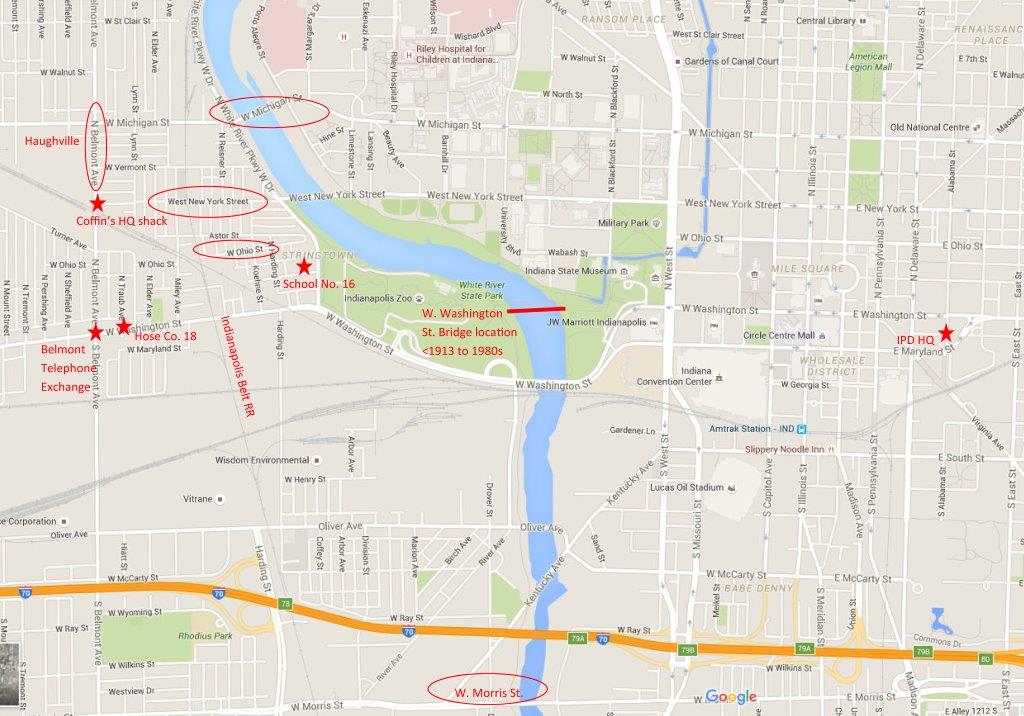
By 8 AM on Monday, March 24, the west fork of the White River through Indianapolis had risen 7 feet in just 12 hours, and was nudging closer to the record high set in 1904. However, the Indianapolis Star stated the danger was not imminent, based on observations of two officers sent out from the headquarters of the Indianapolis Police Department (IPD) to inspect both banks of White River for a critical 3-mile stretch of low-lying land from West Morris Street to West Michigan Street Upon their return, beat patrolmen were ordered to keep an eye on the streams in their areas and raise an alarm as soon as dangerous conditions were seen.

Modern Google map indicating mentioned key locations of IPD action. West Indianapolis is the region lying left (west) of the White River. Note that a fair acreage of the low-lying land inundated during the 1913 flood is now public green space, rail yards, or other industrial land. Railroads in 1913 had different names
Still, the downpour continued in Indianapolis--indeed, across Indiana and beyond.

By just a few hours later (Monday noon), the situation was clearly getting grave. Water blocked by the West Washington Street Bridge—the main thoroughfare (on the old National Road) connecting West Indianapolis on the west side of the White River with the downtown of the main city of Indianapolis on the river’s east side—had risen so far that it began cutting into the banks on both sides of the river, flooding tenement buildings on low-lying land. A corps of mounted police and other police officers—likely bicyclemen (officers on bicycles)—rode up and down the streets of West Indianapolis, warning residents of the danger. Some residents started packing to evacuate but others just greeted them with laughs.

The IPD called out its police reserve with boats. When the boats arrived by automobile, Captain George V. Coffin led a squad to direct rescues of people from the tenements around West Washington Street and elsewhere west of White River. At age 37, Coffin had an impressive resume. He had served in the U.S. Army, including during the Philippine Insurrection and in China during the Boxer Rebellion. He also had experience in desperate rescue efforts: in August 1900 during the Boxer Rebellion, he had helped fight the way into Peking [Beijing] as part of the China Relief Expedition sent to rescue imprisoned U.S. citizens and foreign nationals. 

West Washington Street Bridge an hour before it collapsed. Credit: Indiana Historical Society

Coffin had been appointed to the IPD in 1906 and rose rapidly to sergeant (1908), detective (1909), captain (1910—one of IPD’s youngest). His leadership style inspired loyalty: he didn’t order officers to do things, he said ‘follow me, we’re going to do this’. As the turbulent floodwaters kept rising, Coffin and his men worked tirelessly far into the night, rescuing people in by boat. 

Tuesday, March 25
Despite the undercuts at both ends, the West Washington Street Bridge across the roaring White River was still standing, but its structure was so clearly threatened that before noon traffic across it was suspended except when imperative for rescues. Policemen stationed to guard each end were forced to fight to keep back spectators and anxious relatives, estimated at 30,000.

Still, the rain kept falling and the angry waters kept rising. By boat, Captain Coffin surveyed the situation all around West Indianapolis, telegraphing his findings to Chief of Police Martin Hyland at IPD HQ across the river. Assisted by Sergeant Harry M. Franklin, Coffin developed plans to help the population of West Indianapolis survive the disaster. Franklin, five years older than Coffin, had served in the Spanish-American War and the Indiana National Guard before being appointed drillmaster for the IPD, drilling its mounted and bicycle officers. 

Captain George V. Coffin (middle) and Bicyclemen Charles Gollnisch and Thomas O’Brien (left and right) not only rescued West Indianapolis residents during the 1913 flood but also helped with relief and cleanup after the flood. Credit: Indianapolis Star
All day, Coffin and his men—notably Bicyclemen Charles Gollnisch and Thomas O’Brien—repeatedly rowed a police boat up to rooftops where families had climbed to escape the floodwaters rising around and inside their homes. Family by family, Coffin and his men moved people in flooded homes to School No. 16 at West Market Street and Bloomington St. By nightfall, 470 persons were crowded in the school. 

Late Tuesday, Sgt. Harry Franklin was dispatched from IPD HQ to take sandwiches and coffee to all the men, women and children huddling in School No. 16, and to relieve Coffin and his men. A West Indianapolis boat merchant sent his entire stock of 32 new boats to the West Washington St. Bridge to put them at the disposal of the police and newspapers. When a large, rugged steel Mullins motorboat (this 1913 ad says they were built like “government torpedo boats”) was unloaded, from the crowd an Indianapolis lawyer Cass Connaway and two other men volunteered to drive the boat and man the tiller for Sgt. Franklin. 

The four men battled treacherous currents to steer the motor boat filled with sandwiches and cans of coffee some two miles to the school. “Suddenly the boat was seized by a powerful current rushing like a mill race under the elevated tracks at the Belt,” wrote the Indianapolis Star, referring to the Indianapolis Belt Railroad that circled the city. “The little motor churned the water furiously, but it was an unequal task. They shot through the subway and landed on the shore” on the far side of the tracks from West Ohio Street where they needed to be. 

The West Washington Street Bridge after its collapse; it was Indianapolis’s main thoroughfare crossing the White River (part of the old National Road). Credit: Indiana Historical Society

When the men appealed to a nearby firehouse for help, Fire Captain Marion B. Kemper at Hose Company 18 disobeyed direct orders from his superiors and refused to use firehouse equipment haul the motorboat the needed three blocks to get past the dangerous current. The men managed to borrow a horse and outright stole a wagon from the Belmont Telephone Exchange—grand larceny committed by a lawyer and police sergeant to complete their rescue mission of getting provisions to School No. 16. Reported the Star: “Their boat was soon churning the muddy waters of the night around Ohio street.”

Wednesday, March 26
It wasn’t until around 1 AM Wednesday morning that Franklin and his volunteer companions finally arrived at School No. 16, completely worn out but with the provisions. With Coffin were Patrolmen John Hostetter, Victor Houston, and William Cox, and Sergeant Harley Reed. Thus, along with Franklin, there were scarcely more than half a dozen IPD officers west of White River in the area of Indianapolis’s heaviest flooding. On Wednesday this group dispersed to repeatedly rescue residents.

Some of the rescues were themselves harrowing. On one trip, a man Coffin rescued—apparently driven insane by the trauma of the flood—attacked, and Coffin had to fight him off, the fight lasting all the way to the school. In the same boat were a retarded youth and a blind girl, along with the insane man’s companion, who was rowing. But in the scuffle, the companion fell overboard and was swept away. When the newspapers learned of the incident and wanted details, Coffin—upset at the companion’s drowning—refused to discuss the story further because he wanted to forget it. 

Wednesday morning, four IPD police officers, Captain Coffin, Sergeant Franklin, Patrolmen Houston and Hostetter, along with James Lampkin, deputy city clerk, helped between 450 and 600 flood refugees evacuate School No. 16, now surrounded by water. Credit: Indianapolis Star
Worse, if possible, when he reached School No. 16, he saw with sick dismay that the school, full of wet, cold and hungry people, was no longer a refuge: it was itself now surrounded by rising water. In trips carrying between three and six persons, he ferried them to houses on Washington Street and the Vandalia railroad tracks. Breaking into a grocery store to get them food to eat, Coffin obtained oil stoves, provisions and blankets for people who were being cared for in churches located at Miley Avenue and West Washington Street and at New York Street and Elder Avenue. For the first time in three days, he was able to make contact with Chief of Police Hyland at IPD HQ and requested bread.  

Unloading supplies for flood refugees near Coffin's temporary headquarters. Credit: Indiana Historical Society


The floodwaters crested overnight Tuesday night/Wednesday morning, when the White River reached a height of 25.7 feet, blasting through the previous record of 19.5 feet set on April 1, 1904, and sweeping away the government river gauge. About 1:30 a.m. Wednesday, almost all rescue work in West Indianapolis was stopped, because of the swiftness of the floodwaters’ current, the exhaustion of the workers, and poor visibility due to now-heavy snow. Many persons remained stranded on the roofs of their homes or in the upper stories. Wails of distress were widely reported to be heard in the early hours of the night. As the night wore on, the cries became ever more feeble until around 3 AM a dismal silence hung throughout the area above the turbulence of the floodwaters churning in the river and through the streets.

The night was also punctuated by the horrific roar of bridges collapsing, isolating West Indianapolis. About 8 PM Tuesday night, the Indianapolis & Vincennes railroad bridge was swept away. The Vandalia railroad bridge, south of West Washington Street, began being undermined by the water at 11 p.m. In a desperate effort to weigh it down and save it, the railroad company ran five coal cars out on top of it, two filled with bricks. Too little too late: the Vandalia bridge collapsed at 12:20 a.m. Wednesday.

Remains of the West Washington Street Bridge looking east toward downtown Indianapolis from West Indianapolis, after the floodwaters had receded and the White River was back within its banks. Credit: Indiana Historical Society
The West Washington Street Bridge—then (and still) the major thoroughfare in Indianapolis—was under severe strain, its girders having been struck repeatedly by tons of debris. The floor began slowly crumbling in the wee hours of Wednesday morning. Just before 6 AM, the east span fell into the White River with a crash. The east end of the bridge tore loose from the pier, the road bed sinking beneath the water. The middle span of the bridge also crashed into the river.    

The replacement cost of the West Washington Street Bridge at the time was estimated to be about $200,000 in 1913 dollars (an infrastructure project equivalent to $87.8 million in 2014 dollars, measured as a share of GDP). Indeed, at the time the city’s consulting engineer estimated the loss of bridges and culverts just in Marion County alone to top $1 million (more than $439 million today).
Coffin estimated there were 6,000 to 8,000 homeless people, all of whom were in need of food. He had confiscated all food stocks from every grocery and drug store in the sector and parceled them out to hungry people, but by midday Wednesday nearly all grocery stores west of White River were cleaned out. Coffin ordered that cars of provisions sitting on railroad sidings be broken into. He confiscated the meat from a box car and it was cooked that night in the ovens of Central Hospital.  By then, direct communications between the IPD on the east side of the White River with the police in West Indianapolis was impossible Wednesday as the Gamewell call boxes were out of service. 

Thursday, March 27
By Thursday, the floodwaters were clearly receding. But they were uncovering the muddy wreckage of entire neighborhoods. Many weeks of cleanup and reconstruction lay ahead.

For the duration of his service during the 1913 flood, Capt. Coffin set up temporary headquarters in West Indianapolis on Belmont Ave. at the at the Cincinnati, Hamilton and Dayton railroad tracks, a location that also served as the headquarters for the state militia. Credit: Indianapolis Star
When local newspapers found Coffin on Thursday, he was in his makeshift headquarters in a shack on Belmont Avenue at the Cincinnati, Hamilton and Dayton railroad tracks. Coffin was storing meat, flour and other provisions in churches and other buildings. He was feeding the hungry and giving clothes to the naked. Asked what day he first came out into the flood, he replied, “Let’s see – What day’s today? I’ve lost count.”

Roll of Honor (and infamy) 
In the days following the Great Flood of 1913, Captain George V. Coffin came in for adulation. But his first impulse was to turn the spotlight on the heroic actions of other police officers. He credited about 10 men with responsibility for the effective rescue work done despite West Indianapolis’s isolation at the peak of the disaster. One of these was IPD Sgt. Harry M. Franklin.


On April 9, 1913, Coffin submitted a report of the efforts during the flood to the Board of Safety. It included a list of names of police officers who would eventually have their names added to “The Flood Roll of Honor.” Medals were issued to these men. Eight months after the flood, in November 1913, Coffin himself was appointed Superintendent (Chief of Police). Franklin became instrumental in organizing and serving as marshal in virtually every important parade through Indianapolis for the next two decades until his death in 1935.

Roll of Honor mentioned in the Indianapolis Star, April 10, 1913
Some men were also brought up on charges for shirking their clear humanitarian duty. IPD Sergeant Harry M. Franklin filed paperwork which led to charges being filed against Fire Captain Marion B. Kemper by his superiors for disobeying orders in refusing to transport Franklin’s motor boat of provisions past the ferocious currents at the Belt. That three-block trip might have taken 15 minutes. 

Neither Franklin nor the men assisting him were charged with theft of the wagon in completing their rescue mission, nor were Coffin or his assistants charged for breaking into grocery stores or boxcars to obtain provisions and blankets for flood refugees. Everyone recognized the extraordinarily desperate time called for desperate measures.

Pearsey’s reconstructed 1913 flood roll of honor of IPD officers who served anywhere in the flood zones in Indianapolis (not just where Coffin and Franklin were), based on newspaper accounts and IPD sources.
Unfortunately, today no complete list of the names on the Flood Roll of Honor exists anywhere within the Indianapolis Metropolitan Police Department. The purpose of this historical account is in part, to make sure these officers are forever recognized for what they did in the worst catastrophe to ever strike the city of Indianapolis.

Patrick R. Pearsey is a third-generation member of his family to serve with the Indianapolis Police Department: his grandfather, father, uncle, and brother all were/are IPD officers from 1922 to the present. Hired as a civilian employee in 1980, Pearsey supervised the unit that typed police reports until 2011 when they closed them down.  Now he corrects police reports. Interested in the history of the IPD for more than three decades, he has become a de factor historian of the department, along with several others who are working to preserve the department’s history.  His interest in the 1913 flood also was handed down through his family, who lived just north of the 1913 flood zone; his great aunt Naomi (Pearsey) Page was a schoolgirl and vividly remembered how she and other family members having to dash across the Michigan Street bridge as floodwaters (which carried swimming rats) began covering it. To contact Pearsey, please e-mail me.

©2016 Patrick R. Pearsey

Next time: Crisis Communications in a Communications Crisis

Selected references
The 1913flood in Indianapolis extended miles farther north, south, and west than recounted by this focused guest post, submerging the water works, power plant, and gas works, as well as parts of downtown Indianapolis and elsewhere on the east side of the White River. This story of Capt. Coffin and Sgt. Franklin is just one part of a much more extensive history of the IPD’s actions during the 1913 flood (and biographies of many other IPD police officers) in an 87-slide PowerPoint presentation compiled by Pearsey, based on (among other sources) accounts in the Indianapolis News, the Indianapolis Star, the IPD archives, and the unpublished 423-page PDF Indianapolis Police Department Chiefs of Police 1854–2006 by former IPD police chief Michael T. Spears. 

Brossmann, Charles (consulting engineer, Indianapolis), “Effects of the Flood in Indiana,” Engineering Record 67(14): 372–374, April 5, 1913. Despite the title, the article’s primary focus is Indianapolis.
 
There are many ways to convert the value of historical sums of money. Officer, Lawrence H. and Samuel H. Williamson, “Measuring Worth is a Complicated Question;” for the actual calculator, see “Seven Ways to Compute the Relative Value of a U.S. Dollar Amount, 1774 to Present.”See also their discussion “Choosing the Best Indicator to Measure Relative Worth,” using the cost of constructing the Empire State Building as an example for  an infrastructure project.

Bell, Trudy E., The Great Dayton Flood of 1913, Arcadia Publishing, 2008. Picture book of nearly 200 images of the flood in Dayton, rescue efforts, recovery, and the construction of the Miami Conservancy District dry dams for flood control. Author’s shameless marketing plug: Copies are available directly from me for the cover price of $21.99 plus $4.00 shipping, complete with inscription of your choice; for details, e-mail me t.e.bell@ieee.org, or order from the publisher.